


Crisis Leadership
Major Factors in Crisis Leadership
Crisis Leadership begins with the person. A regular question from clients is, “Can leadership be taught?” The answer is yes. Leadership can be taught. However, formal (Classroom, Tabletop, Simulations/Exercises) and informal learning (on-the-job, peer support, social learning) should be combined with significant self-reflection. Characteristics of a successful crisis leader are embodied by 1) Personality intelligence. 2) Emotional intelligence, 3) Strategic thinking, 4) Set and execute priorities, 5) Manage time, 6) Negotiating for success, 7) Develop teams, 8) Delegate both strategic and tactical priorities, and 9) Provide constructive feedback. These leadership characteristics should be part of leadership training programs, and the leader should be paired with a coach or mentor. They help the learner apply what was learned in training (Gardenier et al., 2020).
In 2020, the World Health Organization (WHO) and the Association of Schools of Public Health in the European Region (ASPHER) published a competency framework for public health professionals. The framework describes knowledge, skills, attributes, attitudes, and behaviors (KSAAB) required to perform a specific job and approach to serving the needs and demands of a population. The framework focuses on three major sections (WHO, 2020):
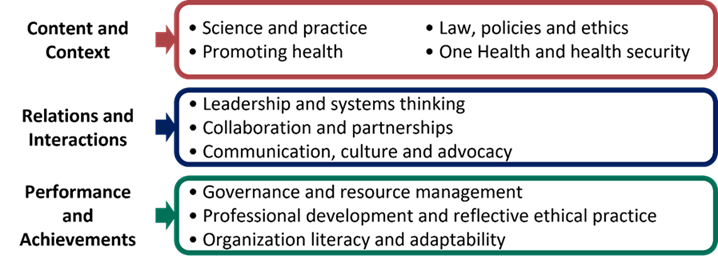
In my opinion, crisis leaders should have the following personal strengths: 1) Execute – making things happen. 2) Influencing – take charge, speak up, and ensure others are heard. 3) Relationship building – the network that holds a team together. 4) Strategic thinking – ability to absorb information that informs better decisions.
One effective leadership strategy that has proven effective is Meta-Leadership. Meta-Leadership is a strategy and practice designed to provide guidance, direction, and momentum across organizational lines that develop into shared actions and a commonality of purpose among people and agencies. Meta-leaders have a deep understanding of themselves and the situations they face. They have a 360-degree picture of the problem, the opportunities, and the potential influence of the people around them that arise from crisis and change. As a result, they have an impact beyond their assigned authority (Marcus et al., 2019).
Training Models
Training models are only effective if they are based on need. Before training is designed, developed, implemented, and evaluated, a needs assessment should be conducted to determine the gaps between the KSAs and the organizational goals and objectives. Additionally, training is a critical component of the emergency preparedness cycle. Individual training models include, but are not limited to: 1) classroom-based courses; 2) e-Learning courses; 3) participation in planning and development of policy, plans, and procedures; 4) internships, fellowships and orientation sessions; 5) site and field assignments that provide training through experience, including lessons identified during real emergencies; 6) participation in exercises, peer-to-peer learning, coaching, mentoring and team-building; and 7) combinations of the above modalities that best meet the individual needs of the leader and the organization (World Health Organization [WHO], 2018).
References
Gardenier, D., Szanton, S., & McBride, A. (2020). Can leadership be taught? The Journal for Nurse Practitioners, 16(6), 414–415. https://doi.org/10.1016/j.nurpra.2020.03.003
Marcus, L., McNulty, E., Henderson, J., & Dorn, B. (2019). You’re It. Hachette Book Group, Inc.
WHO. (2020). Competency framework for the public health workforce in the European region. (WHO/EURO:2020-3997-43756-61569). WHO Regional Office for Europe. https://iris.who.int/bitstream/handle/10665/347866/WHO-EURO-2020-3997-43756-61569-eng.pdf?sequence=1&isAllowed=y
WHO. (2020). Competency framework for the public health workforce in the European region. (WHO/EURO:2020-3997-43756-61569). WHO Regional Office for Europe. https://iris.who.int/bitstream/handle/10665/347866/WHO-EURO-2020-3997-43756-61569-eng.pdf?sequence=1&isAllowed=y World Health Organization. (2018). Part C: training and exercises (Framework for a public health emergency operations centre 2015). Inís Communication. https://www.who.int/publications/i/item/handbook-for-developing-a-public-health-emergency-operations-centre-part-c